Types of Brooms: Indoor, Outdoor, Push and Angle Brooms Explained
Choosing which types of brooms to stock is a range decision, not a single purchase. The tool itself is simple: stiff fibres set roughly parallel to a handle, as Wikipedia describes a broom. The buying is not. An indoor angle broom that suits a supermarket aisle in Manchester is wrong for a forecourt in Durban, and a push broom that flies off a hardware shelf can sit in a homeware catalogue for a year.
Here are the different types of brooms sorted by where they work, what the bristles and head actually do, and the specs worth locking down before anyone quotes you. Blunt opinions included.
Indoor angle brooms: start with the volume item
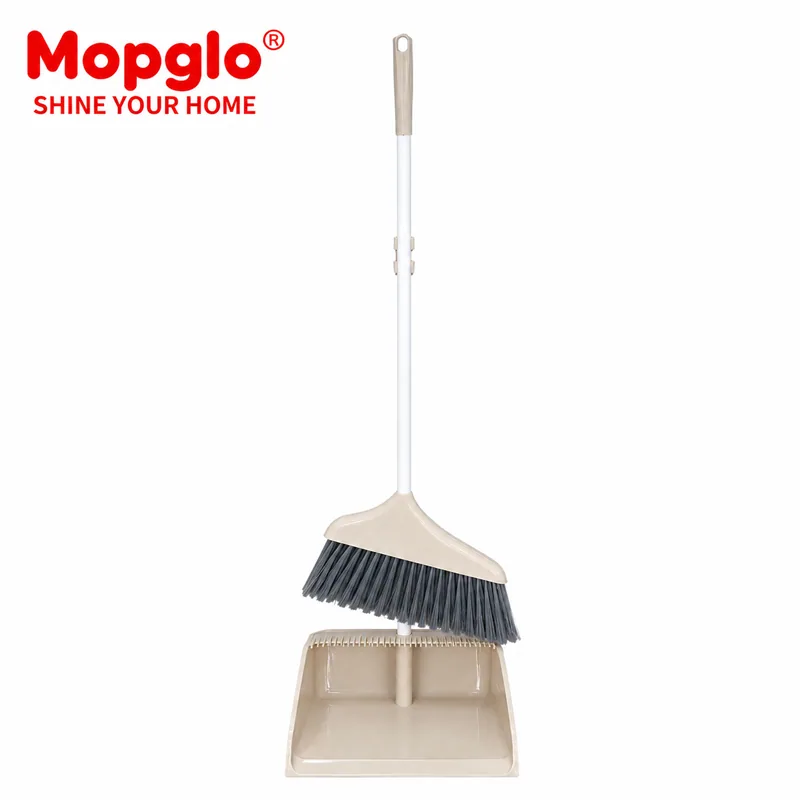
An angle broom has a head cut on a slant, so the bristle line meets a corner instead of riding over it. That geometry is the whole selling point. It reaches skirting boards, the space under a radiator, the corner behind a door. Fine split-tip PET bristles flick flour and dust into a line rather than shoving it along the floor.
Buyers often treat the broom as the product and the dustpan as packaging. Reverse that. A dustpan is a cleaning utensil used with a broom to collect what you have swept, and the front lip is the working part, as the dustpan entry on Wikipedia sets out. A flexible TPR rubber lip hugs a hard floor and picks up the last grey line. A rigid plastic edge leaves it there. If three quotes look oddly far apart, ask what the lip is moulded from.
Then the handle joint. Our indoor handles use reinforced stainless steel or aluminium with a 0.4 to 0.6 mm wall thickness, because a broom that wobbles at the socket comes straight back to the shop. Replacement blocks sit in our range for buyers who want to sell the head on its own: indoor broom heads.
Broom and dustpan sets: the retail-ready format
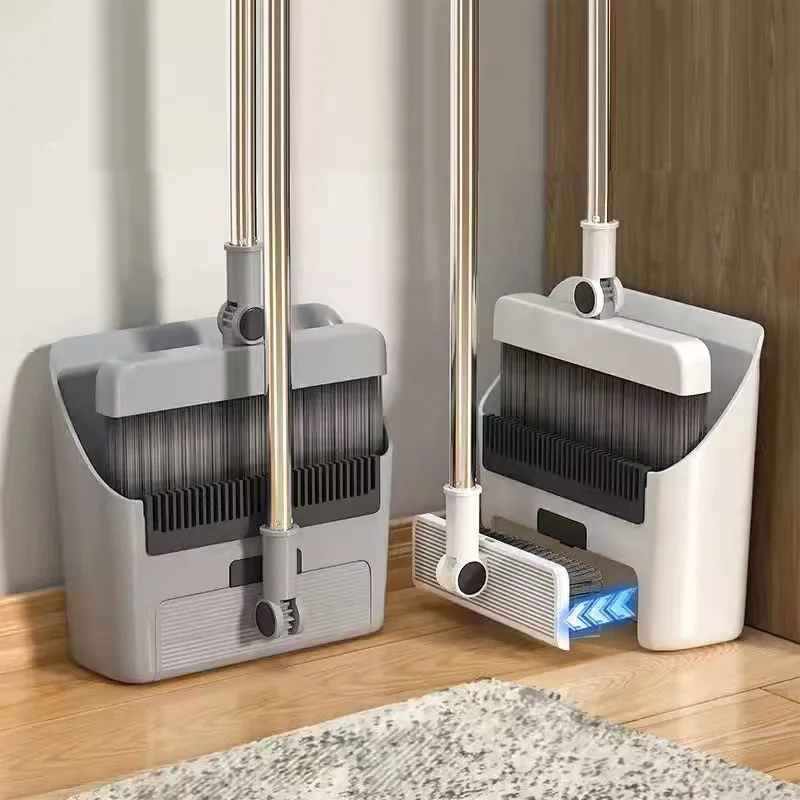
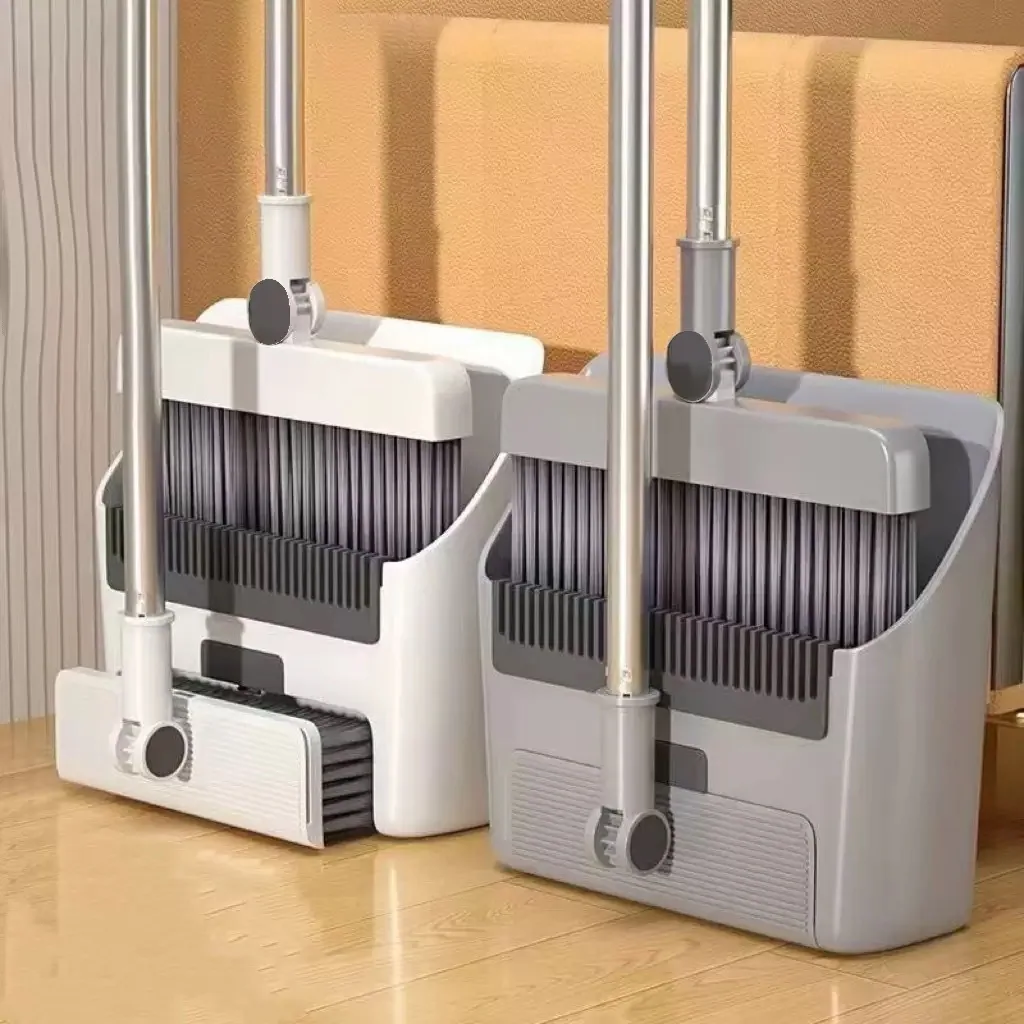
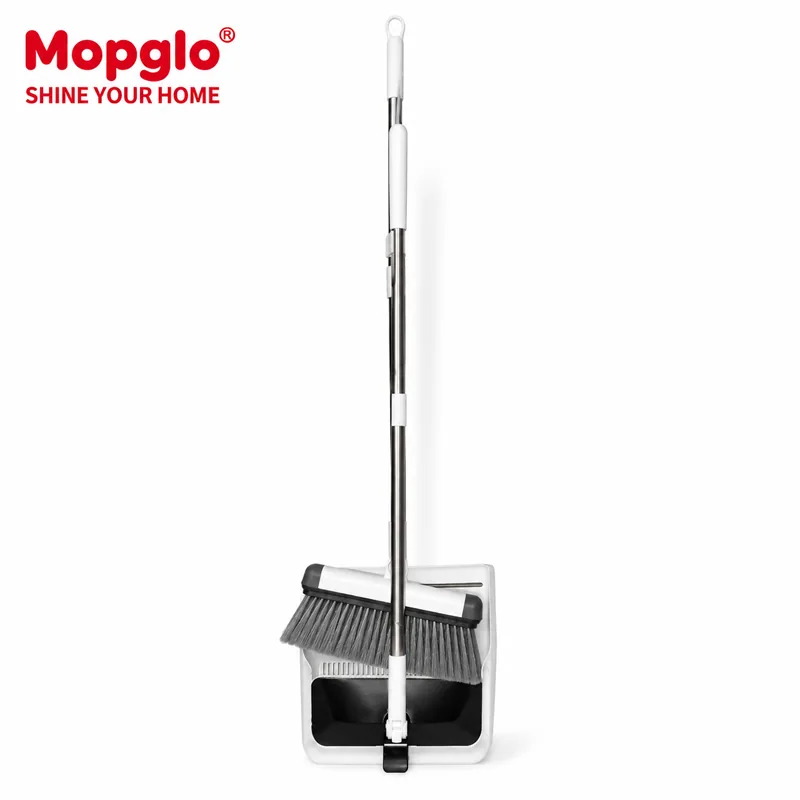
Most shoppers buying an indoor broom buy the pair. Sets come in a few shapes: clip-together uprights, folding designs, compact countertop kits. The Foldable Broom and Dustpan Set is a two-piece kit with a folding windproof pan, packed 30 sets to a carton at a minimum of 300 sets. The Plastic Broom and Dustpan Set with Carry Bar clips into one unit, comes in blue, purple, beige and pink, packs 40 sets to a carton and runs at a minimum of 1,000 sets. The rest of the broom and dustpan sets range covers folding, three-in-one and mini formats.
What to check before you commit:
- Does the broom lock into the pan, or just lean in it? Locking units merchandise better.
- Does the pan stand on its own? Shoppers test this in the aisle.
- How does the hinge or folding joint hold up? A loose joint is a return.
- Carton cube. Thirty sets against forty sets per carton moves your landed cost per unit more than a few cents on FOB.
Outdoor and garden brooms: stiff, wide, weatherproof
Outdoor sweeping is coarse work: leaves, grit, grass clippings, damp patches. The bristle needs to move that without splaying, and the block needs to survive a season beside a door. Timber blocks rot and split. Moulded polypropylene does not. Our outdoor and push brooms range includes a garden broom with a UV-stabilised virgin PP head, which is the spec that matters in a sunny market.
Two buyer notes. Sell the head as well as the complete broom, because replacement blocks are a steady repeat line. And keep the word industrial off a garden broom. Shoppers read labels, then return a product that gravel has chewed.
Push brooms: width and socket are the specs that sell
A push broom is worked with both hands, head ahead of you, in a walking push. That is the practical difference between a push broom and a regular broom: one is built for area coverage, the other for corners and control. We compared them in more detail in push broom vs regular broom. Warehouses, workshops, forecourts, schools and municipal crews are the buyers.
Failures happen in two places: bristle stiffness and the handle socket. Too soft and the broom polishes the floor instead of moving debris. Too stiff on a sealed smooth floor and it chatters. The socket is where cheap brooms die, with a stripped thread or a cracked cone. Our Iron Handle Broom pairs an anti-corrosion stainless steel shaft with a high-impact moulded PP head, and products pass a drop test before they leave the factory.
Silicone and rubber brooms: the demo item
A silicone broom swaps bristles for a one-piece flexible blade. On hard floors it pulls dust, hair and water in a single stroke, and there is no bristle line for hair to wrap around. The Silicone Magic Broom uses a high-density thermoplastic silicone rubber head with a non-porous edge that sits flat on the floor.
These sell on demonstration, not description. Give them a shelf talker or the shopper assumes it is a squeegee. Be honest about limits too: a blade is poor on gravel, leaves and long grass, so keep it in the indoor aisle.
Bristle and head: what actually changes performance
Bristle material is the biggest lever on cost and performance. PP is the stiffest and cheapest of the three common options, chemically resistant, right for outdoor, construction and rough ground, wrong for fine indoor floors. PET sits in the middle: good spring and wear resistance, holds its shape, suits warehouses and mixed indoor-outdoor work. Nylon copes with damp and sweeps gently, so it belongs on indoor floors. Match material to debris size, floor type and humidity, not to a price target.
Then the block. Virgin PP against regrind, UV stabiliser or none, bristle density, staple rows. Our R&D team works on new materials and plastic moulding, and we hold nearly 300 patents across materials, processes and moulds. That matters to you in one way: when a market needs a stiffer bristle or a longer handle, the tooling can move.
| Broom type | Works best on | Typical bristle | Head or block | Spec to confirm |
|---|---|---|---|---|
| Indoor angle broom | Hard floors, corners, skirting | Split-tip PET, fine PP, nylon | Angled PP block | Bristle softness, socket strength |
| Broom and dustpan set | Household kitchens, small retail | PET or PP | Moulded PP, TPR lip on pan | Carton count, lip material, hinge |
| Outdoor garden broom | Paths, driveways, yards | Coarse PP, PP and PET blend | UV-stabilised PP | UV stabiliser, head width |
| Push broom | Warehouses, forecourts, workshops | PP, PET, blends | Heavy PP block, steel socket | Stiffness grade, socket thread, handle wall |
| Silicone or rubber broom | Hard floors, pet hair, wet spills | None, single blade | Thermoplastic silicone rubber | Blade hardness, edge flatness |
| Mini brush and pan | Desks, counters, keyboards | Fine PP or PET | Small PP body | Lip flexibility, pack format |
What to specify before you ask for a quote
Daily sweeping is dry work: no water, no detergent, floor walkable straight away. That is the job your broom has to do well, and it shapes the brief.
- Channel and pack format: shelf-ready single, twin pack, or carton-only for wholesale.
- Head width and broom type: angle, push or blade.
- Bristle material and stiffness grade. Name the floor and the debris, not the price.
- Handle: aluminium or stainless steel, 0.4 to 0.6 mm wall, length, socket type.
- Dustpan lip: flexible TPR rubber or rigid plastic.
- Colour and branding: Pantone code or a physical colour sample, logo by embroidery, silk print or heat print.
- Carton marks and product labels for your market.
- Sustainability: PCR plastic parts or recycled fibre if your buyers ask for them.
One warning on claims. Do not let anyone print a certification or test mark on a box unless the factory has issued the paperwork behind it. Your buyer will ask.
Mistakes that cost money
One broom for every market. A soft indoor broom sold into a dusty, gritty climate fails fast, and a rock-hard outdoor bristle scratches vinyl flooring.
Treating MOQ as a single number. Stock items each carry their own minimum on the listing. OEM has its own range, quoted per style and per colour.
Ignoring the carton. Container maths beats unit price once you are shipping LCL.
Skipping the pre-production sample. Bristle stiffness and colour look different in the hand than on a spec sheet.
How to start an order with CHUANGJIE
Zhejiang Chuangjie Commodity Co., Ltd., trading under the product brand Mopglo, has been making household cleaning tools in Yiwu, Zhejiang since 2006. The range runs to 3,000+ SKUs, there is a showroom of more than 200 square metres in District 4 of the Yiwu International Trade Mart, and 300+ injection moulding machines turn out over 5 million units a year for buyers in 20+ countries.
Two routes in. Stock items: browse our products and use the minimum order shown on each listing. OEM and private label: the MOQ is 2,000 to 8,000 pieces per style per colour, and the flow is straightforward. Confirm quantity, place the order, sign the contract, pay the deposit, then send colour samples or Pantone codes plus logo files. We customise colour, material and style, you approve a pre-production sample, and mass production follows. Handle length, bristle stiffness and mop head material can all be adjusted for a market. Export runs end to end: quality inspection, warehousing and consolidation in Yiwu, customs clearance, booking, FCL or LCL.
Email mopglohome@gmail.com or send the details through the contact form. Tell us the market, the broom types and the pack format, and we will come back with what fits.
FAQ
What are the main types of brooms a retailer should stock?
Four cover most of the shelf: an indoor angle broom or broom and dustpan set, an outdoor garden broom, a push broom for larger areas, and a silicone blade broom as a specialty item. Mini brush and pan sets fill the countertop and desk niche.
Do I need both an angle broom and a push broom in my range?
Usually yes, because they solve different jobs. The angle broom is for corners, skirting boards and control on hard indoor floors. The push broom covers area fast in warehouses, workshops and forecourts. One cannot do the other's work well.
Which bristle material should I choose, PP, PET or nylon?
PP is stiff and cheap, best for outdoor, construction and rough ground. PET balances spring and wear, which suits warehouses and mixed indoor-outdoor use. Nylon handles damp and sweeps gently, so it belongs on indoor floors. Name the floor and the debris when you specify.
Can I order these brooms under my own brand?
Yes. OEM orders run at 2,000 to 8,000 pieces per style per colour. Colours are matched to Pantone codes or your colour samples, logos go on by embroidery, silk print or heat print, and you approve a pre-production sample before mass production starts.